Residential wildlife conflicts in Springfield correlate directly with architectural styles and mature tree canopies. In older neighborhoods like the Historic West Side, Enos Park, and Vinegar Hill, aged fascia boards,…
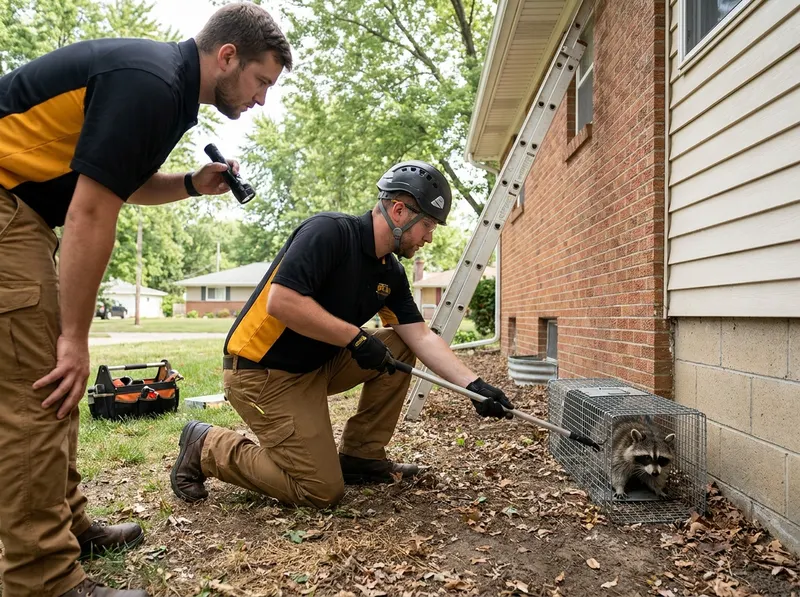
Residential wildlife conflicts in Springfield correlate directly with architectural styles and mature tree canopies. In older neighborhoods like the Historic West Side, Enos Park, and Vinegar Hill, aged fascia boards, uncapped masonry chimneys, and roof valleys allow raccoons and gray squirrels easy access into attic insulation. Properties near open water and wooded corridors, including Laketown, Indian Hills, and Leland Grove near Washington Park, frequently encounter subterranean intrusions from skunks and opossums burrowing beneath concrete porches, low decks, and crawl space foundations. Displaced wildlife also targets perimeter outbuildings around the industrial corridors near the Pillsbury Mills area and open public greenspaces such as Bunn Park.
Effective defense requires distinguishing between open-air rodent trapping and complete physical wildlife exclusion. Over-the-counter live cage traps set on lawns frequently capture non-target neighborhood animals without addressing the opening in the home, leaving the original entry hole open for immediate re-colonization by new litters. A dedicated structural patrol inspects the entire roofline, ridge vents, soffit corners, and louvered gable vents. Technicians install heavy-gauge galvanized steel mesh (quarter-inch hardware cloth), custom sheet-metal drip edges, and spring-loaded one-way exit doors. The one-way door permits actively nesting animals to vacate for food and water while mechanically preventing their re-entry.
State regulations dictate handling protocols across Sangamon County. The Illinois Department of Natural Resources (IDNR) protects native wildlife, mandating specific guidelines for nuisance wildlife control operators. Illinois administrative rules prohibit the unregulated relocation of vector species, including raccoons and skunks, across county lines to halt the transmission of rabies and distemper. Bat mitigation adheres strictly to maternity season blackout windows from May 15 through August 1, during which flightless pups remain inside attic spaces and one-way exclusion valves cannot be installed. Humane remediation requires timing exclusion work outside these reproductive intervals, followed by the complete extraction of soiled insulation and enzymatic treatment to neutralize pheromone trails that attract future animals.
Every job gets a firm, written price after a free on-site visit.
Tell us about your wildlife removal job in Springfield and we'll send a clear, written quote, usually the same day.
 Savero Pest Patrol