Stinging insect populations peak across central Illinois between July and October, as colonies reach maximum worker populations and defend territory near high-traffic residential zones. In Springfield neighborhoods…
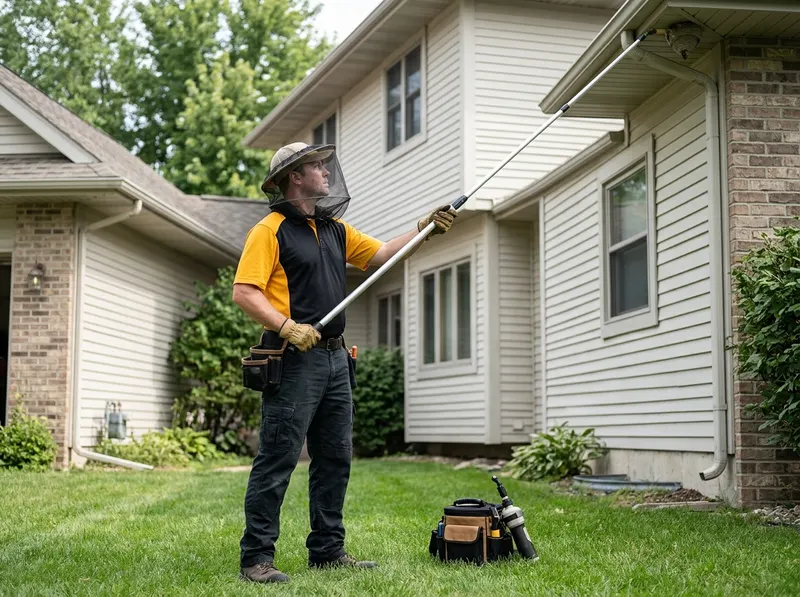
Stinging insect populations peak across central Illinois between July and October, as colonies reach maximum worker populations and defend territory near high-traffic residential zones. In Springfield neighborhoods with mature architectural woodwork like Enos Park, the Historic West Side, and Vinegar Hill, paper wasps and yellowjackets regularly exploit gaps beneath wood lap siding, fascia boards, and decorative porch corbels. Meanwhile, properties bordering Washington Park or the water margins near Lake Springfield frequently experience aerial bald-faced hornet nests suspended 15 to 30 feet in shade trees, as well as aggressive ground-nesting yellowjackets concealed in landscaping beds in Leland Grove and Hawthorne Place. For properties near Bunn Park and the Pillsbury Mills area, structural brick voids and detached garage rooflines present primary nesting voids.
Selecting professional stinging insect control replaces store-bought aerosol sprays that often disperse the colony, driving defensive wasps deeper into attic venting or interior living areas. Over-the-counter pyrethroid sprays typically lack residual perimeter barriers, leaving the pheromone scent intact and allowing secondary swarms to rebuild in the exact same framing within 14 days. Professional control introduces microencapsulated dusts and direct contact residual agents directly into the nest core, neutralizing the queen and foraging workers within 1 to 3 hours while preventing re-infestation of that specific void. The trade-off between localized nest elimination and preventative structural sealing depends on the building envelope: exposed exterior paper wasp nests require simple physical removal following knockdown, whereas yellowjacket traffic entering brick weep screeds requires specialized positive-pressure dusting followed by wire-mesh exclusion to prevent interior wall-void migration.
Occupancy disruption remains minimal during standard exterior applications. Residents must keep windows closed and remain indoors for 45 minutes following direct application, after which treated exterior zones are entirely safe for household use. If an active yellowjacket void breaches an interior drywall seam into a bedroom or kitchen, localized containment curtains are established to prevent insect flight into living quarters during extraction. Standard exterior services do not require signing recurring quarterly contracts; treatments focus on rapid knockdown, nest removal, and the mechanical closing of immediate access points to establish reliable structural defense.
Every job gets a firm, written price after a free on-site visit.
Tell us about your stinging insect control job in Springfield and we'll send a clear, written quote, usually the same day.
 Savero Pest Patrol