Subterranean termites represent the primary wood-destroying pest across central Illinois, nesting deep beneath the frost line in moist soil and building earthen mud tubes over masonry footings to access soft interior…
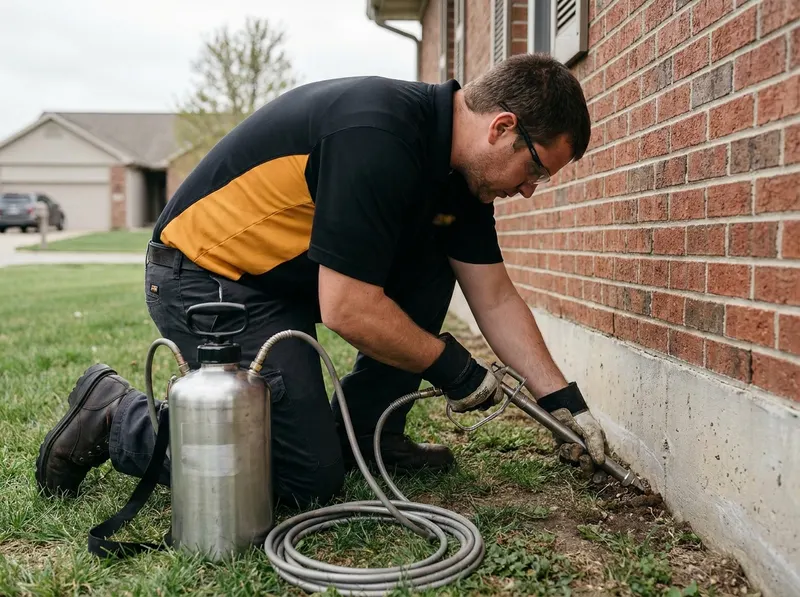
Subterranean termites represent the primary wood-destroying pest across central Illinois, nesting deep beneath the frost line in moist soil and building earthen mud tubes over masonry footings to access soft interior wood. In older Springfield residential districts such as the Historic West Side, Enos Park, and Vinegar Hill, brick foundations often interface with damp rim joists and sill plates, creating vulnerable structural entry points during rainy spring thawing cycles. Properties located near high-water-table zones around Lake Springfield, Laketown, and Bunn Park frequently experience higher colony density due to elevated soil saturation along basements and slab additions. Structural control halts this concealed consumption through subterranean barrier establishment rather than superficial, short-lived aerosol sprays.
Treatment selection depends on architectural design and foundation integrity. A full non-repellent liquid application, such as fipronil applied via trenching and sub-slab injection at a rate of 4 gallons per 10 linear feet per foot of depth, creates an undetectable barrier that termites carry back into the central nest, transferring the toxicant through social grooming within 30 to 90 days. Conversely, properties built on sensitive monolithic slabs or situated adjacent to decorative gardens in neighborhoods like Leland Grove and Hawthorne Place often utilize in-ground monitoring and baiting stations spaced every 10 to 15 linear feet along the drip line. The trade-off centers on response speed versus structural disruption: liquid barriers eliminate the colony faster without recurring station checks, while bait networks avoid drilling finished interior basement floors but require 6 to 18 months for complete colony collapse.
Termite swarmer emergence is often confused with flying ant dispersals; termites feature straight antennae, a uniform broad waist without constriction, and equal-length translucent wings that shed immediately upon landing. Localized spot treatments fit single-area mud tube activity along an isolated porch footing near Indian Hills or the Pillsbury Mills area, whereas multi-level historic homes require a continuous continuous perimeter barrier to ensure subterranean access routes cannot shift beneath untreated concrete. Homeowners remain safely inside the property throughout exterior liquid trenching and bait installations, avoiding the disruptions associated with whole-house structural fumigation.
Every job gets a firm, written price after a free on-site visit.
Tell us about your termite control job in Springfield and we'll send a clear, written quote, usually the same day.
 Savero Pest Patrol